Taught by black and brown belts
Experienced black and brown belts run the kids classes at Wall Street — rare for a children’s program anywhere in the city.
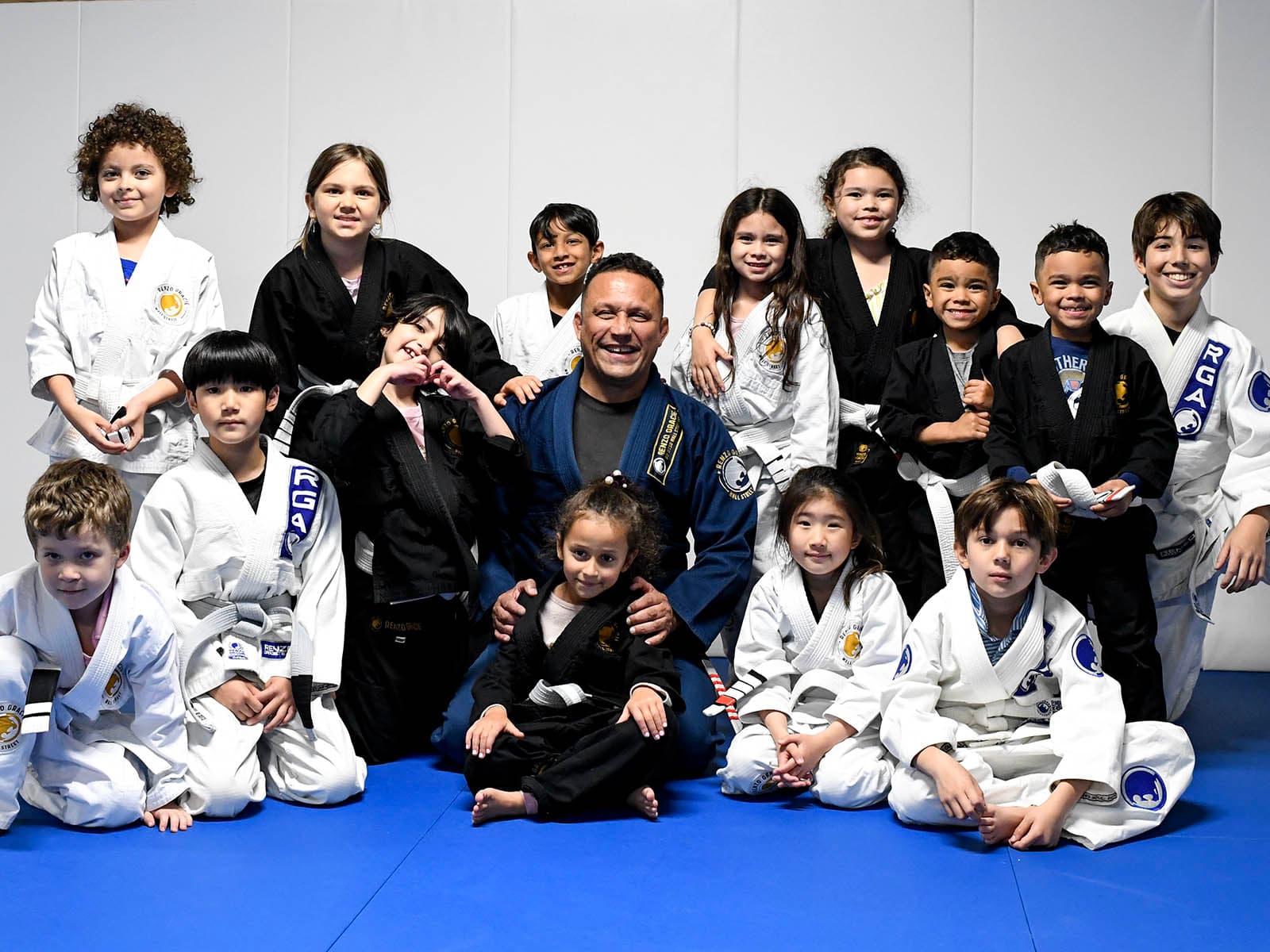
Kids program · Financial District
Nearly 200 children train with us on New Street, in three age groups from 3 to 15, with classes seven days a week. This is what your child will do on the mat, what they will learn, and how they progress.
Jiu-jitsu rests on two ideas we teach from the first class: get the most out of every movement, and make the people around you better. Our children learn to fall safely, to move with control, and to treat their training partners as teammates. Both Renzo Gracie academies in Manhattan run the same program; here is how it works at Wall Street.
Experienced black and brown belts run the kids classes at Wall Street — rare for a children’s program anywhere in the city.
Renzo, co-owner of the academy, brought his game to New York in 1996 and became the city’s jiu-jitsu pioneer. He beat five UFC champions in his fighting career and coached Matt Serra, Chris Weidman and Frankie Edgar to UFC titles.
The head instructor teaches at Wall Street twice a week. He has trained jiu-jitsu for 34 years, taught for 26, holds a judo black belt, and learned from Renzo Gracie, Carlos Gracie Jr., Rickson Gracie and Hélio Gracie.
Every weekday at 5 PM an adult class runs at the same time as ages 9 and up, so a parent can train while their child trains. Unusual in Manhattan, where adult classes usually start at 6.
One of the largest jiu-jitsu academies in Manhattan, on New Street in the Financial District, a short walk from Battery Park City, FiDi and Tribeca.
Wall Street parents single out patient, encouraging coaching with high standards, and real progress for neurodiverse children in body awareness, attention and confidence. More than 50 of our kids train alongside a sibling.
Open a group to see a typical class, how we keep it safe, and what your child learns.
Learn to fall safely, move with control, and treat “fighting” as a game where nobody gets hurt. Techniques arrive the way small children learn best: repetition, games, and plenty of one-on-one time with an instructor.
Children start training with each other, not only with instructors. They learn real techniques, test them against a partner who resists, and learn to keep it safe for both. Every child is also a training partner: helping your partner improve is how you improve.
The same structure as 6 to 8, with more depth. Children learn more detailed techniques, more submissions, and more of the strategy that connects them, on a path toward the adult classes.
Children earn stripes on their belt and, after five stripes, the next belt. Every promotion has two minimums — time since the last one and classes attended — and instructors also look at technique and behavior before promoting.
White → Gray (from age 3) → Yellow (from 7) → Orange (from 10) → Green (from 13). Each color has three steps: with a white bar, solid, and with a black bar. At 16, children move to the adult belts.
Three times a week · What we recommend
Steady progress, and skills that really stick.
Twice a week · A good rhythm
Steady progress for most children.
Once a week · Possible, but slow
A missed week becomes a two-week gap, and from gray belt a stripe takes about four months instead of two. Children notice when friends move ahead.
Plans are available for once, twice or three times a week, and unlimited.
Age sets the range; readiness decides the moment.
The biggest change in the program: longer classes, and training with other children instead of mostly with instructors. We give you our honest recommendation on timing; a child who moves before they are ready often struggles.
Mostly by age. We may suggest waiting a little when a child would benefit from it.
Usually around 13 to 15. For a period, teenagers can train in both the kids’ and adult classes at no extra cost.
See every kids class this week on the full schedule.
Every kids class this week. Pick your child’s age group.
Kids 3 to 5
30 min · Floriano Junior
Kids 6 to 8
45 min · Floriano Junior
Kids 9 and up
45 min · Daniel Souza
Three. Our 3 to 5 class runs for 30 minutes and is mostly falling skills, games and time with an instructor. From age 6, classes run 45 minutes.
Jiu-jitsu has no punches or kicks. Breakfalls come first, tapping and letting go are taught from day one, and partners are paired by size and level. Children under 6 never use submissions on each other. As in any contact sport, bumps and tears happen; we have not had a serious injury, but no sport can rule one out.
Yes. Trial classes are free for families who live or work nearby; book ahead and we will have a loaner gi ready. It is normal for a young child to watch once or twice before stepping on the mat.
Yes, with children aged 9 and up: every weekday at 5 PM, an adult class runs at the same time. Ask the front desk about family training.
Three for the best progress, two for a steady rhythm. One a week works, but slowly: a single missed week turns into a two-week break.
Many neurodiverse children train with us, and we work to keep every child in the group classes. Talk to us before the first class so we can plan together; some children start better with private lessons.
Take the first step. No experience needed, no obligation.
22 New Street
New York, NY 10005
At 22 New Street, on the west side of the New York Stock Exchange between Wall Street and Exchange Place. The Wall Street entrance to New Street is closed to pedestrians by NYSE security — please approach via Exchange Place. From Broadway: walk east on Exchange Place toward Broad Street, then turn left at New Street. From Broad Street: walk west on Exchange Place toward Broadway, then turn right at New Street. Closest stations: Wall Street (2/3), Broad Street (J/Z), and Bowling Green (4/5), with the Fulton Street transit hub (A/C/J/Z/2/3/4/5) a short walk north.
Monday, Wednesday, Friday: 6:45 AM – 8:00 PM
Tuesday, Thursday: 5:45 AM – 8:00 PM
Saturday – Sunday: 9:45 AM – 2:00 PM
Phone: (212) 217-6380
Email: wallst@renzograciewallst.com